

The Unsettling Symphony: AI’s Embrace in the Royal Opera House
The haunting echo of one’s own voice, transformed by the invisible hand of artificial intelligence, can be a profoundly disquieting experience. Singer Patricia Auchterlonie, a seasoned performer at the prestigious Royal Opera House, found herself grappling with this very sensation. “The first portion of the track was somewhat straightforward singing that really sounded like me, which was quite eerie,” she recounted. “And then all of a sudden it does this… what I would describe as almost like a bird call, which is very high and very weird and quite guttural.” This peculiar, guttural sound was entirely new to her, yet now, she can replicate it.
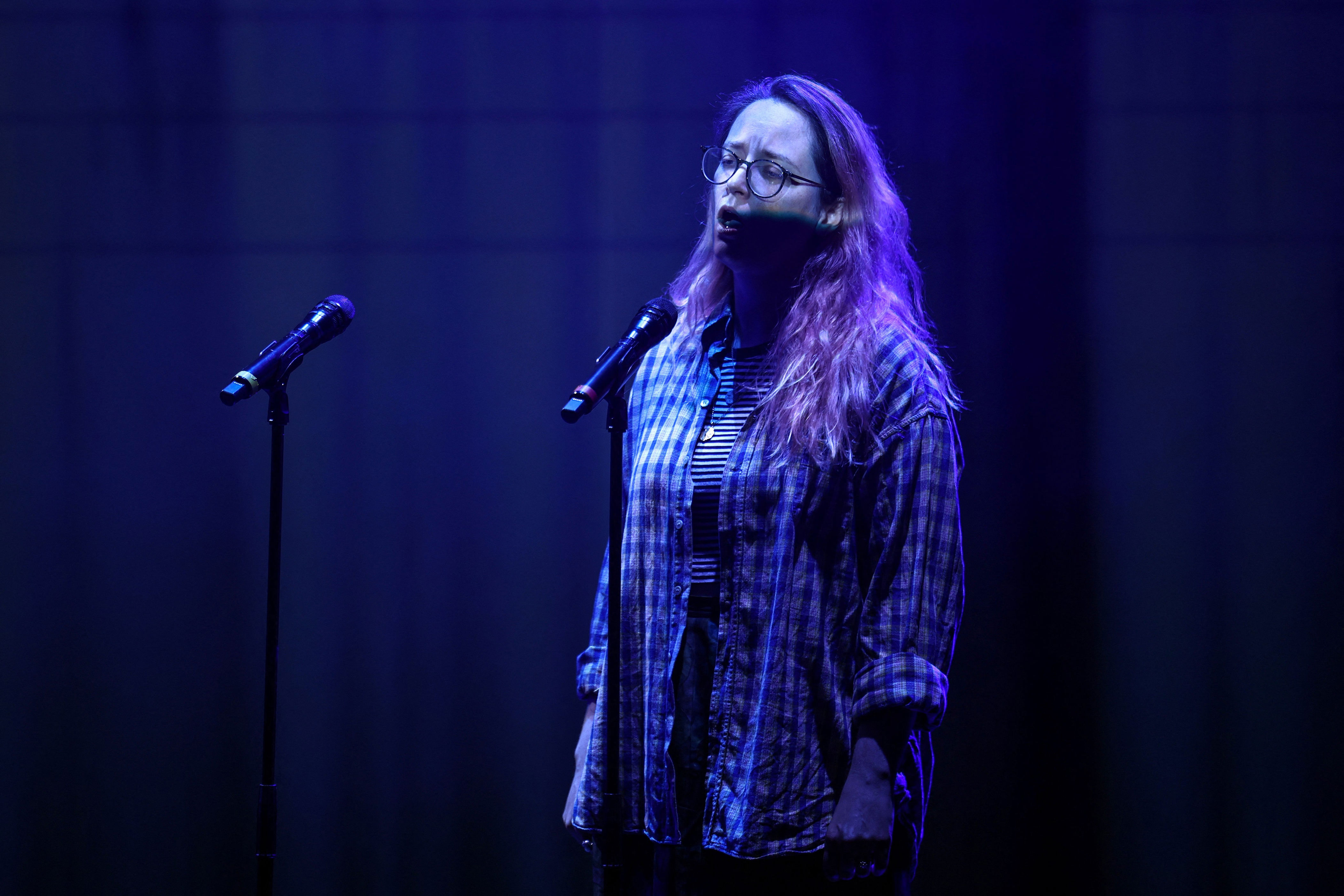
This uncanny rendition of Auchterlonie was a product of artificial intelligence, crafted by beatboxer Harry Yeff, known as Reeps One. Yeff, who is collaborating with Auchterlonie, feeds recordings into AI systems to unearth novel sonic possibilities. Auchterlonie is just one of several artists participating in RBO/SHIFT, an upcoming event at the Royal Opera House designed to explore the burgeoning intersection of opera and artificial intelligence.
However, the prospect of AI’s integration into the performing arts has ignited a firestorm of apprehension. Netia Jones, associate director at the Royal Opera and the programmer of RBO/SHIFT, observes a palpable “crisis in the performing arts with regards to machine learning.” She elaborates, “There’s absolute panic. And in fact last year, when we announced it, some leading people in the arts were describing AI as evil and as the devil, in very emotive language that has continued throughout the year.”
Jones attributes this widespread anxiety to what she terms “emotion-based reporting” on AI. While she acknowledges the distress of her peers, she finds herself remarkably unfazed. “I feel the misery of my colleagues and fellow creatives and practitioners; I don’t feel that personally. So I was thinking this is interesting: why am I not threatened? Why do I not feel so threatened?”
Her equipoise, she explains, stems from two key factors. “Partly it’s because I’ve worked with technology forever. Secondly, it’s because what I do believe is when there is any overwhelming, very dominant technology, certain voices lead – and actually what we need in that space is the subversive voices, the people who are using it wrong, or the artists, the teachers, the philosophers who go into otherwise corporate spaces and start to make mistakes.”
Navigating the Fear and Embracing the Subversive
The reluctance to engage with AI is not a new phenomenon. When Jones organised a similar event last year, inviting practitioners to explore the technology’s potential, the responses were polarized. While some were “excited and inspired,” others were “repulsed, and exited,” a reaction Jones found “quite interesting.” It was from this group of innovators, including Yeff, who had performed in last year’s production of Last Days, that the seeds for RBO/SHIFT were sown.
Jones’s vision for the festival is to foster new perspectives on technology through these unique collaborations. Yet, she understands that widespread acceptance is still a distant prospect. “We have to be teaching the machine really cool things. And there’s enough amazingly cool, brilliant people to be churning some really great things in the machine.” The Royal Opera House, with its deep-rooted tradition and emphasis on human artistry, might seem an unlikely venue for such explorations, but Jones argues this very juxtaposition allows it to be a crucible for diverse ideas.
She anticipates her viewpoints will be met with resistance. “I’m quite excited by change, and I know there are many brain wiring that are not – and that’s absolutely fine. You don’t all have to be ready for the huge seismic shift, but I don’t think the shift has to be so negative; I think there’s space for humanity in a fairly exciting way, and we’ll just see. There’s definitely going to be change, but I think it’s change that we can have agency over, and we can affect, and we can have some kind of influence over.”
Rethinking Ownership in the Age of AI
The changes Auchterlonie foresees extend beyond mere technological integration; they challenge fundamental concepts like ownership. “I think what’s going to be interesting is the idea of ownership – this is the idea that I think I have that’s maybe unpopular, because I know this has been exercising many leading arts voices – is the idea of ownership of copyright. But it’s quite a young idea, it didn’t exist in the 18th century – and you might say that’s because the musicians were suffering and they were treated really badly, which is true, but there will be new paradigms and we have to find new ways.”
She expresses philosophical reservations about the concept of owning an idea. “Philosophically, my brain can’t handle it. I think if you make something, you share it, and it belongs to everybody; I know that’s a bit utopic, and it really freaks a lot of people out because they get so angry about the idea of copyright and ownership, because it’s the only way that anybody can make a living, but I think that’s the bit we need to change.”
This perspective clashes sharply with the concerns of many artists who fear their work will be exploited by technology companies. They worry about the devaluation of their labour and creativity by entities that may show little regard for the time and effort invested. While Jones envisions a utopian creative landscape, the current trajectory of the AI industry appears more focused on data acquisition than fostering such an environment.
“I think the thing you can’t avoid is that there’s a very small number of companies that have trained models, therefore there is this kind of like ludicrous, almost insane Everest of wealth,” Jones observes. “Yeah, the Everest of wealth isn’t even Everest anymore. It’s like this kind of shard of what is so sharp, isn’t it? It’s insane. And the word billionaire now is like hand in hand with AI.”
Finding Agency and Embracing Human Artistry
The concentration of wealth and power in the hands of a few AI giants is a source of widespread discontent, particularly among artists who often struggle financially. “Everybody is a bit revolted by that, it is revolting, especially for artists, because they’re always, you know, scraping,” Jones states. However, she questions the efficacy of boycotting technology solely because it has enriched certain individuals. “But I think if you boycott a technology because it’s made some really unpleasant people really, really, really rich, I don’t know, that just doesn’t seem sophisticated enough to me.”
Jones doesn’t claim to have all the answers but believes in posing different questions. She is sceptical about the potential of extensive litigation to resolve the complex issues surrounding AI and intellectual property. “I think this is it’s much bigger than if you’re if you have a machine learning system that wants everything. It almost obliterates the notion of copyright, because your thing is so tiny, a percent. Yeah, so if you think, OK, well, pay that person for the percentage of what that machine has learned, that’s probably [less than 0.0001 per cent].”
Despite these provocative ideas, Jones clarifies that she has no intention of commissioning AI-generated operas. “If somehow I, as a commissioner, paid whatever corporation to write me an opera in the style of Thomas Adès, and they did that; I can’t see the world where that’s going to happen.” This isn’t due to a lack of capability on AI’s part – “I’m sure it would” – but rather a fundamental disinclination to do so.
“Who would want that?” she questions. “In a lot of this discourse it’s as if there’s nobody making decisions. But there are people making decisions: there’s audiences, there’s consumers, there’s practitioners and all these people. I just can’t see the complete unravelling of something that is very, very central to our existence as human beings.”
The Enduring Power of the Human Touch
Ironically, Jones suggests that engaging with technology could lead to a re-emphasis on fundamentally human aspects of creation. “There’s no reason why we should still be playing the same instruments that we were playing 300 years ago,” she muses. “Why do we do it? We do it because we are moved by it. We love it, and we pursue it with madness. Because to get to a virtuoso level on any instrument, you have to be insanely dedicated, and it is life affirming. When we watch a virtuoso player, or singer, or performer of any kind of level, it’s so exciting because human skill is so exciting.”
She points to the innovative work of artists like Paola Prestini, who has employed AI to enable non-verbal actors to participate in live opera, and Stephanie Dinkins, a transdisciplinary artist exploring how AI can marginalise real voices, particularly those of Black and brown communities. These individuals, along with a diverse group of musicians, AI practitioners, and technologists, will join Auchterlonie on stage at RBO/SHIFT to delve into AI’s impact on the technological landscape.
Auchterlonie’s personal experience with AI has, paradoxically, deepened her connection to organic, human artistry – the kind defined by surprise, eccentricity, and genuine emotion. “For me, that’s what it’s all about: being in the room and – it might sound a bit woo-woo – but to feel the energy of the other performers. You need the human energy.” She believes there is an irreplaceable authenticity in experiencing the human voice directly within the grand setting of the Opera House, something AI cannot replicate.
“AI is just another level of artifice, and already in our society we already function at quite a high level of artifice,” she observes. “When you go see performers, for instance, there’s a series of sort of codified physical and musical languages that we use to indicate to people that certain emotions are being felt, and quite often when you go see live performance and you’re not touched by it, it’s almost as if the person is like putting on a performance of what they think a performance should look or feel like.”
While AI can produce impressive imitations, Auchterlonie remains unconvinced of its ability to capture the profound emotional resonance of human musical creation. “It can generate stuff that surprises you, or is funny, or like sometimes a bit comical, or whatever, but it is ultimately just copying everything.”
The eerily familiar, bird-like call generated by the AI – a virtual echo of her own voice – serves as a potent reminder of this complex relationship. “I discovered that making that sound was quite fun and quite possible – but I found it very eerie how much it sounds like me,” she admits. “I wasn’t really sure about that.”
RBO/SHIFT will be held at the Linbury Theatre at the Royal Ballet and Opera from June 4th to 7th. Further details and ticket information are available at rbo.org.uk.


